




“Solidarity in Sovereignty in Africa” is a call to action for the global community to stand with African nations by respecting and upholding their sovereignty – while recognizing that international assistance remains essential to enable low-income countries to invest the resources needed to close equity gaps and eradicate poverty. To be effective, this support must champion Africa-led priorities, decision-making, and solutions, respond to local needs and contexts, and recognize African leadership as central to shared global progress. In this second blog from our Black History Month series, we had the honour of speaking with Fara Ndiaye from Speak Up Africa who spoke powerfully about the need for the future of Africa to be led by Africa.
Hello! It’s a pleasure to speak to you. I am Fara Ndiaye. I am the Co-Founder and Deputy Executive Director of Speak Up Africa, an advocacy organization based in Dakar, Senegal, focused on catalyzing leadership to advance the achievement of the Sustainable Development Goals across the African continent. I split my time between Dakar and Toronto, where my family is based.
At Speak Up Africa, our main objective is to take ownership of the challenges facing the continent. We believe that for Africa to effectively address the issues that affect people’s day-to-day lives, it is essential to build sustainable and diverse partnerships, so that everyone has a seat at the table.
Too often, public policies are developed in very elitist ways, and we strongly believe that the people closest to the problem are also the ones closest to the right solutions. That’s why we spend a lot of time thinking about capacity strengthening and changing ecosystems. In practice, this means countries should invest in capacity strengthening for government representatives and civil society organizations alike. We place a strong emphasis on amplifying the voices of local actors and stakeholders, because it’s vital to showcase the impactful work already happening on the ground.
While it’s important to call out the challenges that persist, it’s equally important to highlight the best practices being developed by African stakeholders themselves. A core part of our role is to shine a light on these successes and to help secure international platforms where African leadership and solutions can truly be seen and heard.
For me, solidarity in sovereignty is really the core of the issue we all need to focus on. It means the world standing with African stakeholders, not standing in our place. It’s about recognizing that African governments, communities, civil society organizations, and opinion leaders are best positioned to define our own priorities, our own timelines, and our own trade-offs.
Solidarity is not about directing or substituting leadership. It’s about aligning behind African leadership in a way that is respectful, predictable, and accountable. It also requires asking ourselves some very hard questions: Who is deciding? Who is benefiting from these decisions? How do we remain accountable? And how do we challenge systems that continue to reproduce inequality? These are essential questions.
For me, the ultimate form of solidarity, especially when we talk about Africa, is not to speak for Africa, but to create the conditions for African agency, leadership, and sovereignty to be fully exercised. I despise the word empowerment, because it suggests that power is being given to communities, when in reality, they already know what needs to be done. The issue is ensuring they have the agency and space to be their own spokespeople.
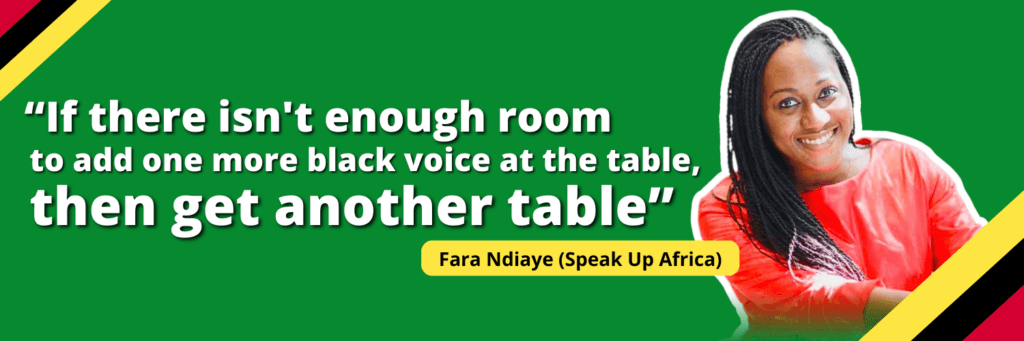
There is a real tendency to speak for Africa. As a Francophone from Senegal, I’m often asked to speak for all of Francophone Africa – this simply cannot be. If the problem is that there aren’t enough seats at the table, then we need another table. We need to diversify partnerships so that the full diversity of the continent – its perspectives, experiences, and realities – is properly represented if we are to move forward.
Ultimately, solidarity is about making room for more voices, not falling into the trap of always speaking on behalf of others. We need to create the conditions for African leadership to lead.
And in a context of shrinking aid, solidarity in sovereignty isn’t a political slogan. It is the only viable pathway to long-term, sustainable impact.
What we are seeing on the ground is not a lack of leadership, innovation, or resilience. African-led organizations and communities have demonstrated extraordinary resilience over decades of shifting priorities, recurring crises, and chronic underinvestment. International assistance has played, and continues to play, a critical role in supporting this resilience, particularly in sustaining essential services and protecting hard-won gains.
The real challenge today is that this support is becoming increasingly volatile and unpredictable, stretching communities and organizations to their limits. Abrupt funding withdrawals, often with little or no transition planning, disrupt essential services and erode trust in public systems. At the same time, African-led organizations are expected to sustain impact while navigating short funding cycles, shrinking support, and heavy compliance requirements. This forces many into survival mode – constantly adapting, absorbing shocks, and filling gaps – rather than being able to plan, innovate, and lead.
For me, resilience should not mean endlessly coping with instability. It should mean having the political space, financial predictability, and institutional strength to lead, supported by reliable, well-aligned international partnerships. This is an opportunity to rethink how resources, authority, and accountability are distributed, so that international aid strengthens domestic systems rather than substituting for them.
The real risk is systemic: when funding exists without deliberate choices to support domestic ownership and sustainable financing, the entire system is weakened, including the institutions it is meant to strengthen. Used well, however, international assistance remains a powerful tool. This moment gives us a chance to reset the rules of engagement in ways that truly honour African leadership, while ensuring aid continues to deliver impact where it is most needed.
My starting point is always internal change. Africans on the continent have important work to do among ourselves to strengthen ownership, leadership, and accountability. We need to clearly understand where our power lies – across value chains, institutions, and decision-making spaces – and what it takes to fully own the choices that affect our communities.
That said, the African diaspora is large, influential, and holds significant potential for collective impact, particularly in donor countries. Black History Month may be a Western construct, but the connection between the diaspora and the continent is real. One important opportunity is for diaspora communities to help shape public and political conversations in donor countries around aid reform and more equitable partnerships. Their proximity to decision-makers and public discourse gives them a unique role to play. For donors, this means engaging the diaspora not as implementers of parallel projects, but as partners and advocates who can help push for long-term, nationally aligned investments.
Finally, narrative matters. Donors often underestimate how powerful storytelling is in shaping policy and funding decisions. The African diaspora is well positioned to challenge deficit-based portrayals of Africa and to amplify African expertise and success on global platforms. We tend to believe what we see. Showing what African leadership and success look like, and backing them with sustained, predictable financing, is essential.
READ ON: solidarity through Pan-Africanism and rising to the challenges – reflections from Senior Policy and Advocacy Officer Dominique Denoncourt.
New stories every Friday throughout Black History Month — follow our LinkedIn newsletter The Informed Advocate to stay in the loop!