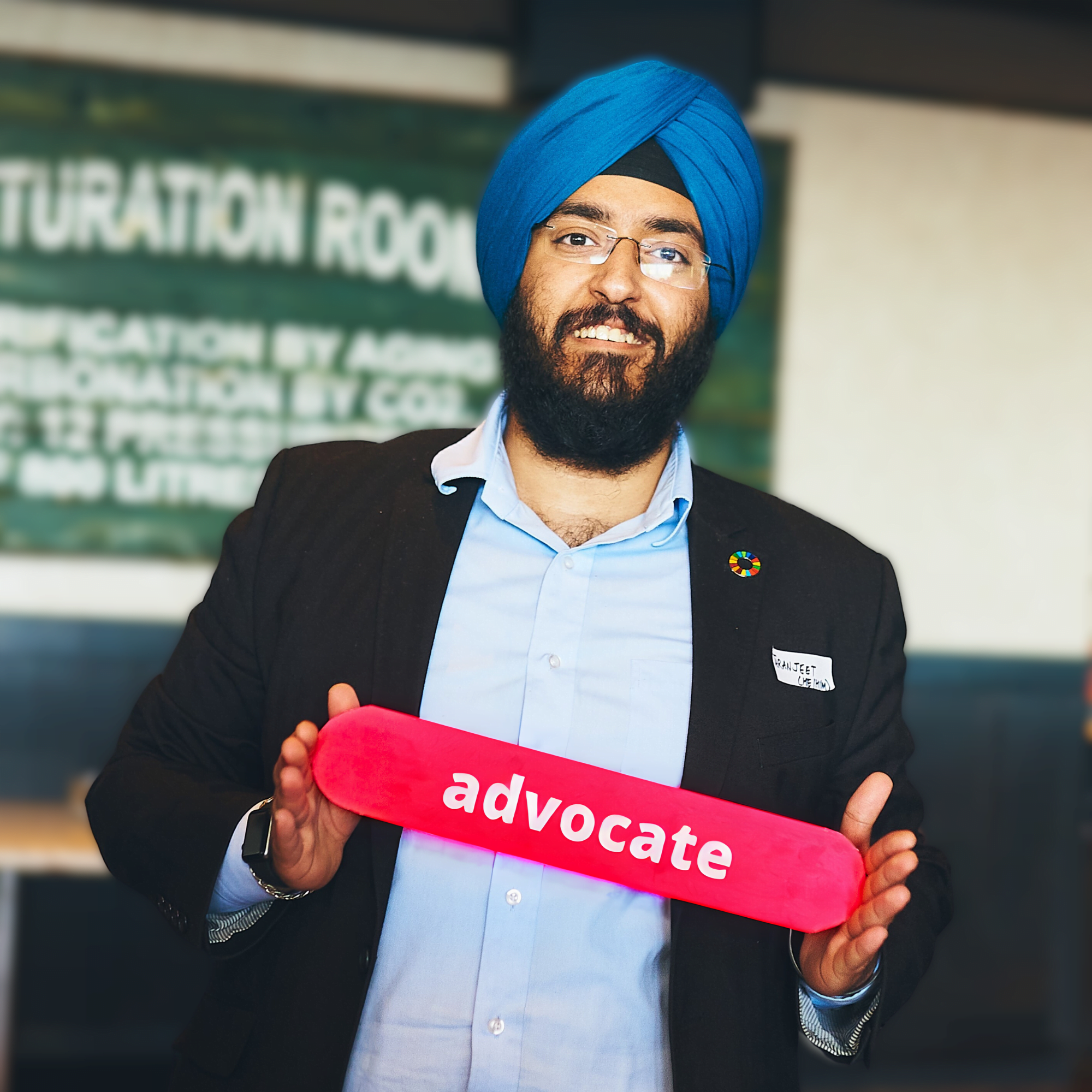





“Right now, Canada’s international aid is not meeting our global moment of need – but that can change. As other countries make the dangerous decision to reduce their international aid, Canada can choose to stand up in this difficult time and lead with our strong values. "
- Budget 2026 Advocacy Toolkit, Results Canada

Every budget is a choice – about what a government values enough to protect, and what it’s willing to let go. While security and economic growth have been this government’s stated priorities, it’s important to remind our decision-makers that these priorities aren’t at odds with international assistance – they are built on it. Less than 1% of federal spending delivers outsized returns on both fronts, and in a world this interconnected, those choices matter well beyond Canada: what happens elsewhere shapes what happens here too. And right now, behind closed doors, those choices are being made.
If we want Budget 2026 (expected in October or November) to reflect us, our values, and our belief that extreme poverty can be ended, we need to ensure that Canadian decision-makers know that people in this country care.
Too often politicians say that their constituents and voters don’t care about international assistance. We know that’s not true. Every month, hundreds of Results volunteer advocates take action, and millions of Canadians give their hard-earned time and money to hundreds of organizations that build healthier and more prosperous communities around the world.
The ask: We call on Canada to stop cuts to international aid in Budget 2026 and reinvest in our world.
Canada has a longstanding non-partisan legacy of supporting the health, rights, and wellbeing of people around the world – a legacy people in Canada are justifiably proud of. For decades, across governments, Canadians have contributed to advancing health equity, education, and efforts to prevent disease and conflict. Open the dropdown ↓ to learn more.
It’s thanks to the leadership of countries like Canada that our world is healthier and more prosperous than it was only 20 years ago. One of the greatest accomplishments of this millennium has been the reduction in child mortality rates to the lowest point ever. This means that more children are able to grow up and experience everything life has to offer – and Canada played a major role in this monumental achievement.
However, even this is under threat. 2025 is the first year this century where child deaths will have increased, because, while famine, conflicts, and crises have spread and intensified, wealthy countries turned away and cut international assistance. Canada did, too. Despite promises to the contrary, Canada cut international aid by $2.7 billion over 4 years.
Pulling back from our world when Canada was needed most was the wrong choice.
The G7 countries, which provide roughly three-quarters of all aid, are on track to cut aid spending by 28% in 2026 – that's the largest reduction ever recorded by G7 members. The effects of these cuts are sobering, and could result in:
We are seeing the cost of cuts play out before our eyes as the Ebola outbreak continues in the Democratic Republic of Congo and Uganda. Many experts say the devastating aid cuts slowed the identification of the Ebola outbreak and the virus could have been spreading for weeks before the outbreak was declared. Even now, measures to stop the spread of Ebola are hampered by a lack of funding which has made contact tracing more difficult and delayed getting personal protective equipment to teams on the ground. Read our case study for more.
By addressing the root causes of poverty and instability abroad, international assistance delivers concrete outcomes that reinforce Canada’s economic prosperity, national security and global influence.
Trade & Economic resilience: Aid diversifies Canada's trade beyond the US: every $1 invested in international assistance returns $1.19 in Canadian exports. Past aid recipients like Chile, South Africa, and Vietnam are now key trading partners.
National Security: Conflict prevention is 60 times cheaper than fighting wars; every $1 spent on prevention saves $16 in humanitarian response. Aid stops instability abroad before it reaches Canada.
Pandemic preparedness: Aid keeps us safe from global pandemics. Every dollar invested in pandemic preparedness, prevention, and response yields roughly $14 in economic and health benefits.
Made-in-Canada solutions: Canadian researchers and manufacturers are studying infectious diseases (see our map), developing innovative health tools, producing emergency food, and so much more. Investing in aid supports their work, boosts our economy, advances domestic innovation, and strengthens resilience.
As advocates, we’ve made a different choice: we choose to fight for progress, health, and justice; we choose our world. And it’s our responsibility to call on our government to do the same.
The ask: We call on Canada to stop cuts to international aid in Budget 2026 and reinvest in our world.
latest campaign news
Secure The Future
story
Our budget toolkit contains case studies on how cuts of international assistance are impacting real people on the ground. Check them out to gain awareness and to help you when making your case with your MP or others as to why we have to stop the cuts:
video
Learn more about how Canada’s federal budget process works, and why it’s important for advocates to engage from Althia Raj, a National Columnist with the Toronto Star and a seasoned political reporter.
August 6: Results Canada Action Kick-Off
August 12: International Youth Day
August 19: World Humanitarian Day
August 20: World Mosquito Day
X tags: @ResultsCda, @CanadaDev, @MarkJCarney,@FP_Champagne, @AnitaAnandMP, @RandeepSSarai, @YasirNaqviCDN
The next few months ahead of Budget 2026 are a critical time for advocates from across Canada to take action and let decision-makers know that you care about the fight to end global poverty.
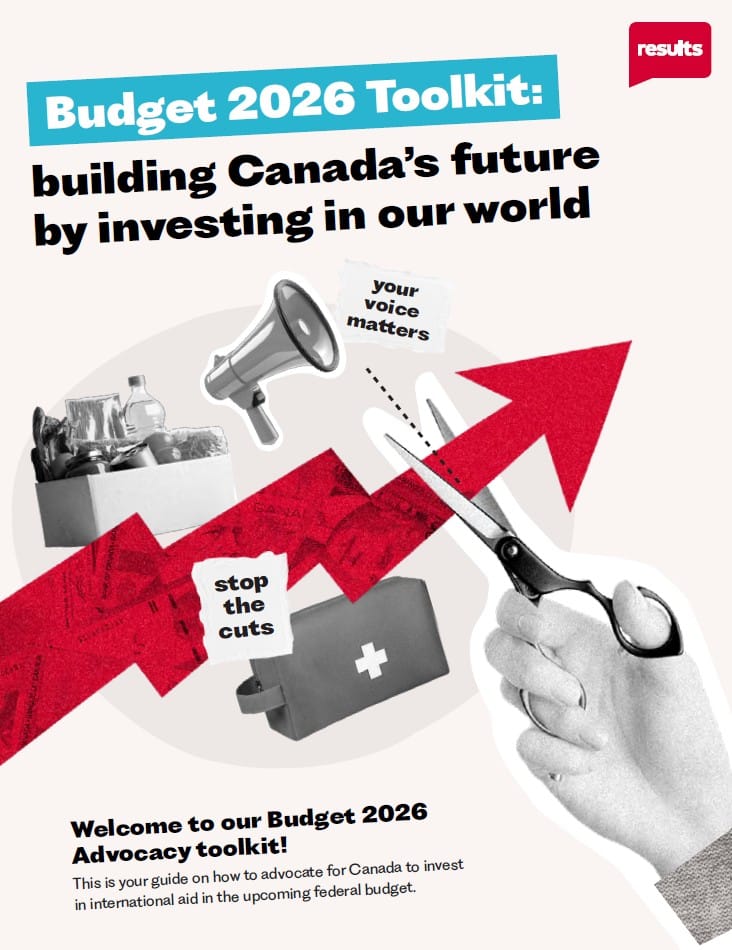
To help, we’ve created a budget toolkit with the actions and resources you need to build momentum ahead of Budget 2026 over the next few months. Check it out and take action today!
Expert tip: smart advocates don't work alone, and they let others know when they've done impactful actions. Make sure to report your actions!
Did you know that your Member of Parliament (MP) has an office dedicated to serving your community? Most MPs have a constituency office right in their riding with the purpose to serve and hear from community members like you!
Take some time this month to stop by your MP’s constituency office, drop off our Budget 2026 leave-behind, and have a chat with your MP’s staff about why cuts to international aid must stop in Budget 2026.
If your MP doesn’t have a public constituency office or no one answers the door, try giving their office a call instead!
To find out who your MP is and get their office address and phone number, type your postal code here, and click contact.
Your letter to the editor can help shift the conversation. Government representatives are deciding right now how Canada will show up at the G7 Leaders' Summit in June – and public pressure matters. Write to your local or national newspaper and make the case that pandemic preparedness is not a foreign aid issue. It is a security issue, an economic issue, and a values issue. Use the ongoing Ebola and hantavirus outbreaks to demonstrate the urgent need for investments in pandemic preparedness through CEPI.
A personal connection makes letters stand out. Whether you are a health worker, a scientist, a parent, or simply a Canadian who lived through COVID-19, your experience gives readers something statistics cannot. All the facts and figures you need are in this call to action.
To further increase your chances of publication, submit your letter to the editor to local and community newspapers.
Volunteers on average spend 1-2 hours researching and planning, 30 minutes writing their draft, and 15 minutes submitting it to newspapers.
Vaccines a light of hope for children
While at times we can feel overwhelmed by all the bad news, there are many candles fighting the darkness. Critical health measures are succeeding around the world — even as the media focuses its attention elsewhere.
Since its inception in 2000, the International Vaccine Alliance Gavi, has helped vaccinate more than half the world’s children, reducing vaccine-preventable deaths by a staggering 70 per cent. In 1980, child mortality for children under five years old was 250 deaths per thousand live births. Today, it’s about 50.
We can keep the good news coming. The next round of funding for Gavi approaches and Canada’s share is $720 million. It’s critical the federal government steps up with its share of funding to vaccinate half a billion children in this next round. A half a billion candles to light the darkness.
Nathaniel Poole, Victoria, B.C.
Nov 16, 2024 in the Regina Leader-Post
See more published volunteer LTEs.